
The Webshop Is Merely the Tip of the Iceberg: HUF 7,000 Billion in Corporate Revenue Mapped Across Digital Commerce. Hungary’s Digital Commerce Ecosystem Revealed as a Whole for the First Time
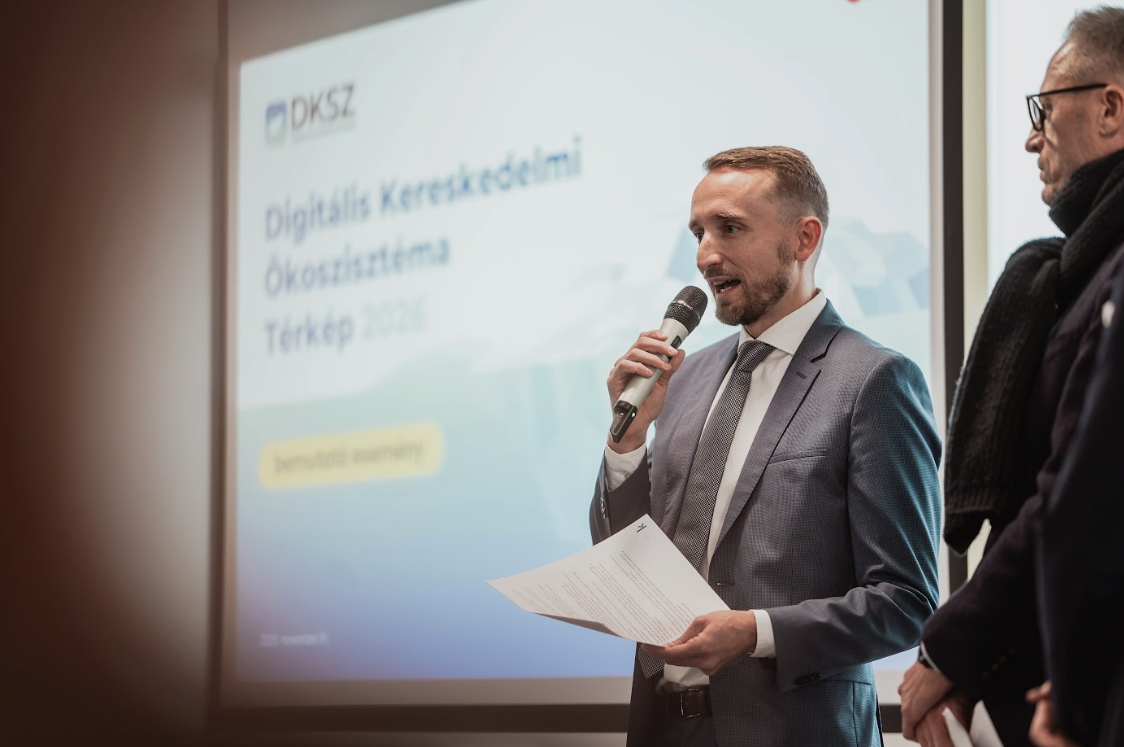
On 19 November, at a professional event in Budapest open to the press, the Digital Commerce Alliance of Hungary (DKSZ) unveiled the first consultation version of its Digital Commerce Ecosystem Map before an audience of government and industry stakeholders. Developed with the support of Mastercard, the map is structured around four layers and 36 categories. It offers a clear view of a segment of the Hungarian economy that has until now remained largely uncharted, spanning webshops, technology, payment and logistics providers, and regulatory institutions. The initiative brings into focus a community of players whose combined corporate revenue exceeds HUF 7,000 billion. Its central message is that the true economic significance of digital commerce becomes apparent only when the ecosystem is viewed in its entirety, and that the competitiveness of Hungarian players can be meaningfully strengthened only through a holistic approach.
Consumers typically encounter little more than a webshop’s storefront, yet the fulfilment of every online order relies on a carefully orchestrated network of service providers and back-end systems. Just as the online retail of physical goods is inconceivable without logistics, successful digital sales are equally dependent on robust technological, financial and service infrastructure.
This ecosystem perspective is embodied in the very composition of DKSZ. Its founding members are leading figures in digital technology and advertising, payments, delivery, warehouse logistics, industry advocacy, digital marketing, research and consulting, and the development of digital commerce systems.
Government, Industry and Expertise at the Same Table
The event brought together the leadership of DKSZ, government representatives and the alliance’s founding companies. The morning opened with a presentation of the alliance’s strategy by László Ocskay, President of DKSZ, Norbert Madar, Vice President, and Pál Bíró, Country Manager of Google. This was followed by the government keynote, delivered by Dr. Tamás Kozák, Deputy State Secretary for Trade at the Ministry of Economy and Energy.

László Ocskay and Norbert Madar then outlined the origins of the map, its architecture and the principles underpinning its classification. Norbert Madar went on to present the principal findings of the Digital Commerce Overview, jointly published by PwC and DKSZ, while Tibor Berkes of Mastercard delivered a presentation entitled „The future of finance is built together”.


A panel discussion on the future of digital commerce and its implications for the national economy was moderated by Csaba Árvai, featuring Pál Bíró (Google), Laura Magyar (Ministry of Economy and Energy), Szilvia Nagy (DHL Express) and Krisztina Tajthy (IVSZ). The event concluded with closing remarks by László Szabó, Managing Partner of Growww Digital, who also set out the alliance’s next steps.


Four Layers, One Market
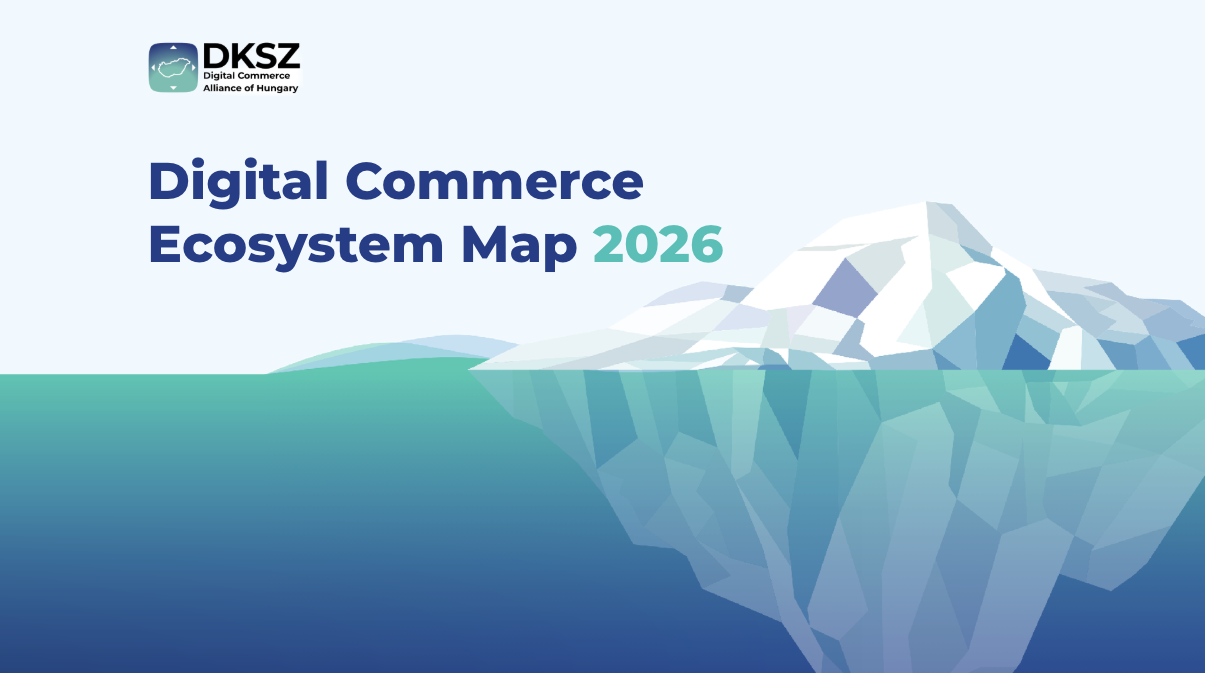
The first two layers, situated above the waterline and directly visible to consumers, comprise merchants of goods sold through digital channels, together with businesses offering services and digital goods online.
Digital commerce extends well beyond webshops selling physical products. It encompasses a broad spectrum of sectors, from travel and ticketing to digital content and software subscriptions.
The third layer consists of the ecosystem service providers that support merchants, among them providers of technology, payments, logistics, marketing, customer service and business support.
The fourth layer brings together the organisations that shape the operating environment, including public authorities, industry associations, educational and research institutions, as well as consumer protection and financing bodies.
Across the map’s layers and categories, numerous Hungarian enterprises compete successfully alongside their international counterparts.
The question of Hungarian competitiveness therefore cannot be reduced to how domestic webshops fare against global platforms. Of equal importance are the development and support of the Hungarian technology, logistics and professional service providers behind them, as well as a thorough understanding of the sub-markets in which they operate.
What Do the Market Size Figures Reveal?
As the depth of available data varies considerably across segments, market size estimates and the aggregate revenue of the companies concerned must be considered separately.
In keeping with the map’s iceberg analogy, the most substantial group above the waterline is, unsurprisingly, that of online retailers, of which more than 30,000 operate in Hungary. According to PwC, approximately HUF 400 billion of this market, valued at around HUF 2,100 billion, is attributable to cross-border imports.
Drawing on existing market research and measurements, it is also possible to quantify several significant digital transaction and service sub-markets within the ecosystem. PwC estimates annual revenues of approximately HUF 100 billion for digital content, HUF 50 billion for ticketing, HUF 11 billion for accommodation booking and HUF 30 billion for classifieds. The logistics market responsible for delivering merchants’ orders is likewise estimated by PwC at around HUF 230 billion.
Owing to differences in scope and to overlaps between segments, corporate revenues and sub-market turnover cannot simply be aggregated. The map instead establishes a common framework for future comparable research. A unified measurement spanning the entire ecosystem and each of its levels thus remains a task for the years ahead.
The Competitiveness of the Hungarian Economy Rests on the Ecosystem as a Whole
„One of the most important messages of the DKSZ digital ecosystem map is that, today, commerce is the very last thing a digital merchant needs to be an expert in”
– observes Norbert Madar, Vice President of DKSZ and Director heading PwC’s digital commerce advisory practice.
An excellent product and strong sales capabilities are no longer sufficient in themselves. Technology, data, inventory management, payments, logistics and customer service must all operate in concert. This does not require every capability to be developed in-house; rather, success lies in selecting the right partners and interoperable systems.
„Discussions of Hungarian e-commerce tend to revolve around webshop rankings, yet the competitiveness of domestic merchants depends at least as much on the service providers behind them and on the regulatory environment. Competing with global platforms on price alone is a formidable challenge, but in the quality of customer experience, Hungarian players can hold a genuine advantage. To realise it, one must understand who is who in the market, and this is precisely the insight the DKSZ ecosystem map now provides”
– remarked László Ocskay, President of DKSZ.
Where Is the Market Heading by 2030?
To strengthen exports, domestic value creation, productivity and consumer trust, initiatives affecting digital commerce must account not only for merchants but also for the service infrastructure behind them and the broader operating environment.
The map can provide a shared foundation for four strategic directions, both for the alliance and for public policy:
- the renewal of export programmes;
- targeted support for Hungarian market players;
- omnichannel initiatives that integrate online and offline sales channels;
- and the development of regulatory and support proposals.
„We designed the map for merchants, service providers, regulators and policymakers alike, so that the development of Hungarian digital commerce can be discussed on the basis of a shared understanding and a common vocabulary. Our aim was not to produce yet another list, but to make the intricate workings of the market accessible and to draw attention to the factors that most decisively shape the competitiveness of Hungarian players,”
– added Norbert Madar, Vice President of DKSZ.
How Was the Map Developed?
Alongside a review of existing research, DKSZ experts analysed more than thirty Hungarian operational case studies in order to develop a category system that could be applied consistently to business activities that frequently overlap.
Rather than relying on a company’s primary registered activity, the classification reflects the substantive role it plays in digital commerce. A single company may simultaneously act as a merchant, a marketplace operator and a technology or logistics partner to other merchants. The classification is further enriched by attributes describing customer base, target countries and sales channels.
Seven practical questions guide users through the service provider categories:
- What am I selling, and how do customers discover me?
- Where and how do I sell?
- How do payments reach me?
- How does the product reach the customer?
- How do I retain my customers?
- What runs behind the scenes?
- Who helps me operate effectively and in full compliance?
In this way, the map can also assist Hungarian businesses in identifying the service providers required to achieve a specific business objective, such as international expansion or entry onto a marketplace.
Market players were identified through industry compilations, research and publicly available sources, including PwC’s E-toplista, Growww Digital’s HungarEcomm Stars, the Oander Omnichannel Scale research and the OPTEN company database. The map is neither a ranking nor a representation of partnerships, nor does it claim to be an exhaustive list of market players. The absence of any company implies no professional judgement, and DKSZ membership is not a prerequisite for inclusion.

DKSZ Ökoszisztéma Térkép 2026
A webáruház csak a jéghegy csúcsa: 7000 milliárd forintnyi vállalati árbevétel a digitális kereskedelem térképén – először látható együtt a hazai digitális kereskedelmi ökoszisztéma A Digitális Kereskedelmi Szövetség november 19-én, egy budapesti, sajtónyilvános...

Top 50 CEE Online Exporters 2024
How the top 50 Online Exporters in the CEE region perform? - report by Growww Digital The "Top 50 Online Exporters in the CEE Region" report by Growww Digital analyzes the performance of e-commerce exporters in Central and Eastern Europe. While the sector experienced...

Digitális Kereskedelmi Körkép 2024/II.
A hazai e-kereskedelmi piac 2024-ben olyan átalakuláson ment keresztül, amelyre 25 éves fennállása óta még nem volt példa 2024-ben a teljes magyar e-kereskedelmi piac a PwC Q1-Q3 közötti mérései és Q4-re vonatkozó előzetes adatai alapján 15%-os árbevétel-növekedés...

Új lendület a digitális kereskedelemben
Megújult a Digitális Kereskedelmi Szövetség vezetősége Az átalakulás célja, hogy a szövetség hatékonyabban reagáljon a digitális kereskedelem előtt álló kihívásokra, elősegítse a hazai szereplők megerősödését és az exporttevékenység fellendülését. A Szövetség...

Digitális Kereskedelmi Körkép 2026/I.
Már a szolgáltatási szint és a vásárlói élmény a legfontosabb versenytényező az e-kereskedelemben A magyar e-kereskedelmi piac 2026 első félévében tovább bővült: az első negyedévben 14,2%-kal nőtt az előző év azonos időszakához képest, az online vásárlók száma pedig...

E-toplista 2025
Változatlan az élmezőny a PwC E-toplistáján: a forgalom a legnagyobbaknál sűrűsödik az e-kereskedelemben Idén is az Alza vezeti a PwC 2025-ös E-toplistáját, a dobogón pedig a tavalyi sorrendben a Kifli.hu és a MediaMarkt követi. A 11. alkalommal megjelent kiadvány az...

HungarEcomm Stars 2026
Szakmai érték a trófeán túl Már harmadik éve fut a Growww Digital által életre hívott kezdeményezés, amely a nemzetközi szinten is versenyképes, legvilágpiacképesebb magyarországi vállalatokat ismeri el – legyenek e-kereskedők, omnichannel szereplők vagy akár gyártók...

2026 E-kereskedelmi Trendjei Webinár
Vonjuk le együtt 2025 tanulságait, hogy felkészülten vághassunk bele az idei év kihívásaiba! A Digitális Kereskedelmi Szövetség az Ecommerce Expo főszervezőivel közös évindító webinárt szervez a nemzetközi piacokat meghódítani vágyó magyar e-kereskedők számára. A...

Omnichannel kereskedelmi menedzsment képzés indul
A Budapesti Corvinus Egyetem elindítja az ország első Omnichannel kereskedelmi menedzsment executive képzését Hazánkban elsőként – az OANDER Technologies Kft. partnerségével – indul képzési program omnichannel témakörben, amely valódi, „boardroom-ready” tudást ad a...
